JUICE-y Topics Transcript
JUICE-y Topics
Shaili Samuel: This podcast is part of the Rhodes College Just Food series, which addresses food inequality through discussion of production, access, distribution, and consumption in Memphis and beyond. In this semester-long project, students and community members have come together to promote empowerment through awareness and equity.My name is Shaili Samuel And I’m Maaike Liguori and we will be hosting this episode of “JUICE-y Topics”
Maaike Liguori: Shaili and I are both Rhodes Students, but not locals to the Memphis area, so exploring the city has been an important part of our college experience thus far. For this podcast, we wanted to highlight a neighborhood that is close to Rhodes yet not well known amongst the student population. The historic Orange Mound neighborhood is just a 10 minute drive from campus but somewhere I had never been. Orange Mound was the first African American neighborhood in the United States and was once a thriving and self-sufficient community. From Melrose High School to Orange Mound park, to successful local businesses, Orange Mound was an autonomous, lively, and successful neighborhood, and a symbol of inspiration and economic progress in the 1970s.
Shaili Samuel: Today, the neighborhood looks very different from it’s previous self. As a result of redlining and continued disinvestment, Orange Mound has been faced with overwhelming vacancy and deterioration of resources -this is especially observable with food access in the neighborhood. My initial interest and passion for the Orange Mound neighborhood was sparked by a fellowship that I was involved in this past summer where I got to work directly with Ms. Britney Thornton, a community organizer and head of the nonprofit JUICE, Orange Mound. I worked at The Hub at Orange Mound, a homeless shelter on Park Avenue that serves shelterless members of the Orange Mound and Memphis community. A lot of my experiences over the summer were in some way connected to food. I watered the community gardens and got to interact with community members in these spaces. I also got to see a lot of the process of food donation at The Hub. The dichotomy between working at the Hub with people who had extremely limited access to healthy food, then driving back to Rhodes and having the privilege of eating at a dining hall with endless food options, was really impactful to me. In today’s episode, Maaike and I want to share the story of food access in Orange Mound to create a different form of advocacy for this neighborhood and open up conversations about what we can do as members of the Rhodes and Memphis community to create food equity in the city.
Maaike Liguori: Today, we will be sharing with you interviews from Ms. Britney Thornton at JUICE, and one of the residents at The Hub Orange Mound, Mr. Raymond Westbrook, to gain insight into what they see as the biggest obstacles to food equity in this historically neglected and underserved community.
Shaili Samuel: We want to start off with a quote from Mr. Westbrook, that we think really gets to the foundation of the importance of food -
Raymond Westbrook: What does food mean to you?Survival, Sustain my body thats what it means. Can’t live without it.
Maaike Liguori: Food is survival and yet not accessible to so many in Orange Mound, in Memphis, and beyond.
Shaili Samuel: Here is a little bit about what Britney has to say about access to healthy food in the neighborhood -
Britney Thornton: For me, food justice has to be about like things being comparable. Right? I think a lot of times people will say, Oh, you know, like when we lost our Kroger, they replaced it with a super low. But to me, that was an injustice because it locked us in to a certain caliber of food. I mean, it's weird because it's like, you know, when I was in school, there was a term called learned helplessness. And I mean, it's hard to really put a data point around it because people are so accustomed to just doing like adapting to whatever you do. You took our food source, our primary food source for a year and there was no marches. There were no, you know, shutdowns. There were no, you know, mass pack out to government meetings like there was no type of like civic response. So to me, the lack of action was very telling. And there's there's just this like question of like, what do people believe that they deserve? Because if you were to take away something from more affluent communities, the response would have been way more grim, you know, worse? Yeah, I'm saying like and you wouldn't even have gotten to that point because you would never even think to do it because you would be afraid of the consequences. So I don't know what lack of power orange mayor actually has for that to have been such a process. People did not. I mean, it randomly popped up, I think, like within a week of notice, like it was closed. And then afterwards, like there was no type of like there was, there were a couple of meetings. But after those meetings, there were no follow ups. So it's like literally went dark, you know, who does that? You know? And who do you do that to, you know? So it just felt like a done two situation.
Maaike Liguori: As Britney briefly mentions there, the only Kroger in nearby vicinity to the Orange Mound neighborhood, located on Lamar Avenue, was shut down in 2018 and replaced by a SuperLow. SuperLow has a much more limited stock of fresh fruit and vegetables, and greatly limits this communities access to healthy foods. This has lent to the characterization of Orange Mound as a food desert, and connects to the concept of food apartheid as reflected by the continued disinvestment in neighborhoods like Orange Mound.
Shaili Samuel: JUICE conducted survey’s to collect data on the communities response to this action, here she describes some of the results of this survey:
Britney Thornton: We did this interesting study when Kroger closed and we asked people like What level of store would you like to have? Would you like a value store, a regular store or an upscale store? And the data revealed that most people said they want at least a regular and a lot of people want it like an upscale store. So people, actually, if given the option, would like the best option, which makes sense because any given person then walks around has an ego, right? And not many people are saying, Please give me less than, you know, I'm like, That's a that's a that's the thing that we do because we decide that. And and so, you know, if it costs more to get nicer products, then let's talk about how to allow people to be in a position to afford better products. Yeah, rather than just choosing that, you're going to get off brand things for the rest of your life or you're going to get things that are unhealthy compared to what other people get, you know? Or you're only going to have bananas, apples and oranges and never see, you know, Kiwis in, you know what I'm saying, like it's I don't want to say who gets to decide that. So food justice to me has to round out the options conversation to be able to say that no matter where you are in your life, your socioeconomic status, you will have options to the full smorgasbord of like whatever is available, you know?
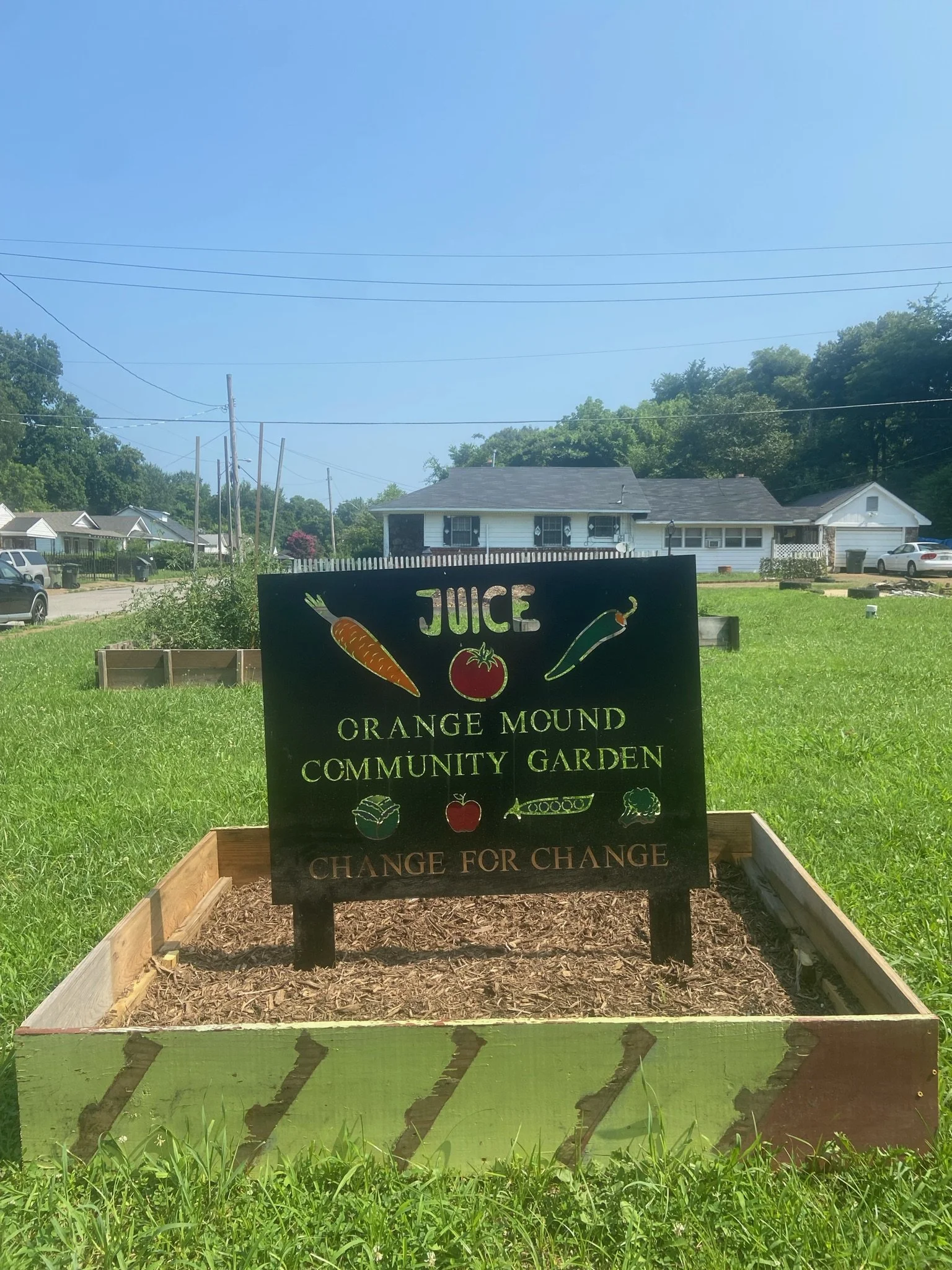
Shaili Samuel: To combat this lack of options, Britney and JUICE have set up community gardens around the neighborhood that allow for growth of fresh fruit and vegetables. Here is what Ray has to say about some of the crops and what he cooks with them -
Raymond Westbrook: What do you grow at the gardens? Tomatoes, peppers and. Herbs like. Peppermint.Use a lot of them,
Maaike Liguori: Britney describes the gardens as more than a food resource -
Britney Thornton: I view gardening more for its programmatic aspects. Yes, the fact that people are like doing things productive and just like the excitement of watching you still grow. Then we did have a supernova or do something that that was pretty cool. He took ghost peppers and made a sauce. And so that was really cool. Oh yeah. Explore ideas of him being an entrepreneur and maybe, you know, packaging his ass to sell it. You know, I just thought that that train of thought was really cool. So hopefully next growing season, we can do that as well.
Shaili Samuel: As Britney is saying, these gardens reach so far beyond providing fresh food -they open a door to entrepreneurship for roommates at the hub, and connect the community through shared work on the garden and enjoyment of the fruits of their labor. Here, Britney talks a bit more about the entrepreneurial future directions of the garden -
Britney Thornton: Before the garden season, I was like, Oh, be so cool if we could create our own souls. You know, like, I mean, we were growing tomatoes and peppers and herbs like surely those like the major ingredients for salsa. What would it look like for us to create a co-op where we're like, you know, brand it, you know, orange around grown salsa like something? I just love the entrepreneurial spin of things because people have to sustain themselves, and we live in an age of people wanting to create passive income. So how can even for the unsheltered or the homeless? Like how can they start your group like streams of revenue to be able to sustain themselves in new ways?
Maaike Liguori: Shaili and I also had some questions about local restaurants in Orange Mound and what food options they had -
Britney Thornton: Our healthy options here are very limited. So if I were to sustain myself exclusively with a diet and orange mound, I don't think I would live very long was in the fast food restaurants, you know, things like high sodium, like saturated fat, you know, like, yeah, yeah, it's not a lot of healthy food options. And so when I'm outside of the neighborhood, I'm getting those options, you know, I'm going down to Midtown. I'm going to other parts of town with their select restaurants that I go to get, you know, more balanced meals. So I would want that for Orange Mound.
Shaili Samuel: Here is Ray talking about his favorite Orange Mound restaurants
Raymond Westbrook: I just really had started working at a restaurant orange mound grill, but I haven't been there in a couple of day. Peavy, chitlins or baked chicken. Oh my little Petey Greene, pinto beans, black eyed peas in hot water, cornbread pies and stuff like this. That's known restaurant I really go to. Like the other restaurants like fast food. I really don't like fast food.
Shaili Samuel: We asked Ray where he would go if he was looking for something vegetarian or a salad. Here’s what he had to say -
Raymond Westbrook: Oh, really, I don't think anybody I had to sell. Oh, wait a minute. Yes, do I would have to go to marathon. The gas station? Yes, they say they have. They'd make up and said, Yeah
Maaike Liguori: Ray and Britney both comment on the lack of diverse and nutritional options in the neighborhood, representing another barrier to food equity in Orange Mound.
Shaili Samuel: But what will we see in the future for Orange Mound? What is to come? Here is Britney’s image -
Britney Thornton: Everything will be about security and agency and not security like Crimea. It's just security like you aren't concerned about finances. So it's like if your roof needs to be fixed, you have the provision either directly or indirectly to do it. So I would say that we would be a connected and organized community where people know their neighbors, where you know our vacancy and by feel, you know, like we have the density that we need to be a respected community visually, like we look like a high functioning community. There's a lot of like commerce and just activity out, you know, you walk and you see people walking down the street. You see people come in the shops, you see people playing in the parts like, you know, just very like physically, visibly present community. And then, you know, on the social service side of things. I think the highest level operating for us is for us to like, do things at a recreation and not have a need. So I think the difference between program and juicers compared to go beyond like they're planning like fun things, you know, they're doing for dollars and food festivals and concerts. And we're trying to get babies diapers that community baby shower. So we're trying to feed people like we're doing things that are very low on Maslow's hierarchy of needs. So us working through programing that actually helps people self-actualize, you know, people travel, people, you know, like travel clothes, you know, they're like fun stuff that isn't like if you don't get a you on that tomorrow type thing. Mm-Hmm. So that would be ideal, and costs really does make a difference. But I think more than anything, we're realizing that we are able to operate independent of government and that we're able to do a lot for ourselves. So the biggest thing is going to be just connecting our people because Orange is a heavily resourced community like just opening up.
Maaike Liguori: Lastly, we wanted to know what the Rhodes community can do as a part of creating this image. Here is Britney’s response -
Britney Thornton: I think that the tension between a rose and orange mound is huge. And like y'all just being here physically like present like it matters. Mm hmm. And in your, you know, seemingly white bodies and you don't sound like in these spaces like it really does do really strong reconciliation work. And so I hope that we can just scale this to be able to continue to model what that looks like and really just speak to like, you know, these tensions, if we just lean in to them, we can do a lot.
Shaili Samuel: Opening up conversations about ourselves as students at a predominantly white institution in a heavily diverse city is essential in fostering food equity in neighborhoods like Orange Mound. We present this podcast to you in an effort to synthesize these conversations and bring awareness to the struggle that exists so nearby yet is so disregarded by our Rhodes community.
Maaike Liguori: Our hope is that we can further emphasize the importance of collaboration between Rhodes and Orange Mound to help bring healthy food to neighborhoods in need and to create awareness of topics in food justice.
Shaili Samuel: Thank you for listening and we hope you enjoyed this episode of JUICY Topics