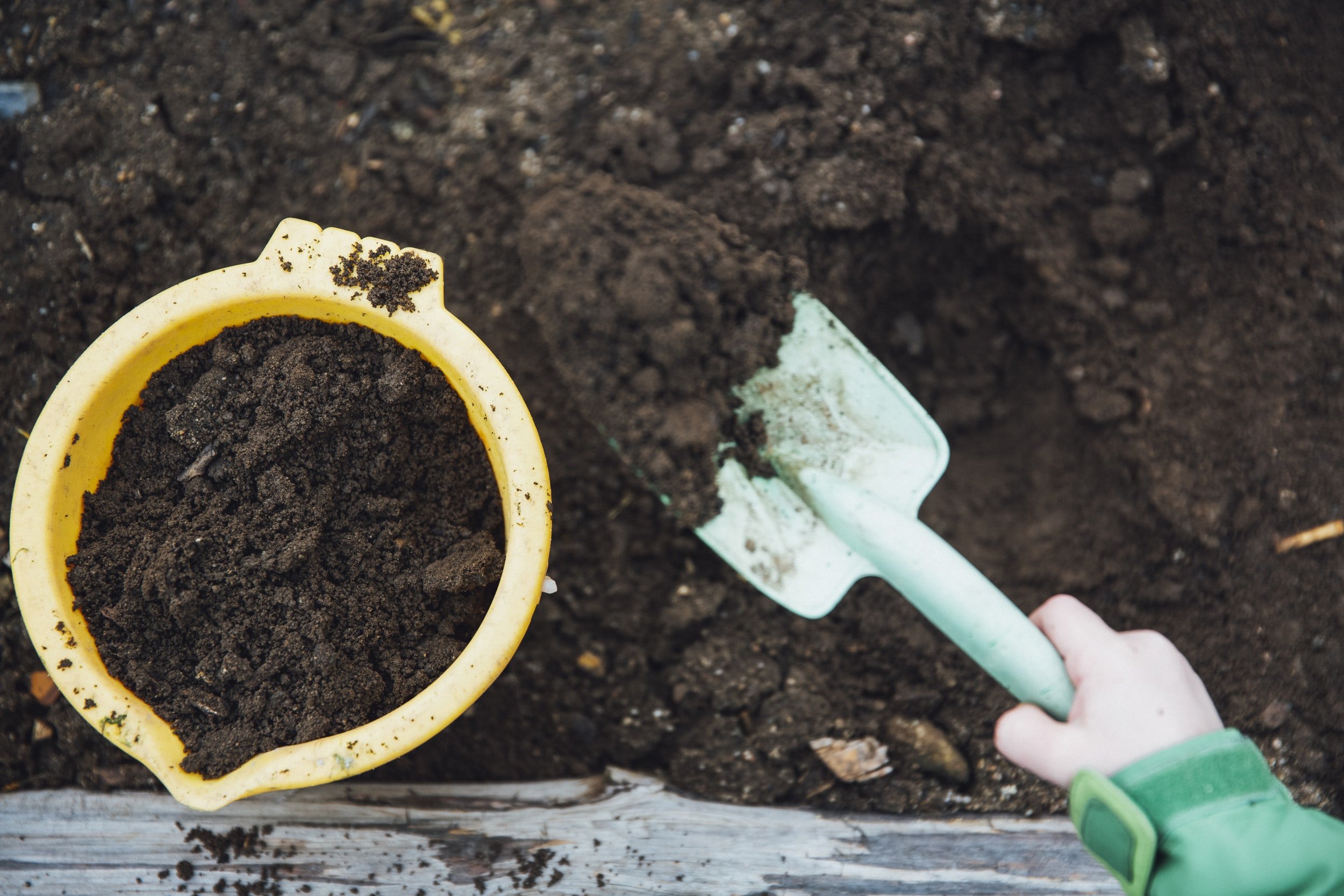
Decomposing Food Injustice Through Composting Transcript
Decomposing Food Injustice Through Composting
Carolyn Bruce: This podcast is part of the Rhodes College Just Food Series, which addresses food inequality through discussions of production, access, distribution and consumption in Memphis and beyond. In this semester-long project, students and community members have come together to promote empowerment through awareness and equity.
Hasan Hamada: I’m Hasan Hamada!
Chiara Torrini: I’m Chiara Torrini!
Carolyn Bruce: And I’m Carolyn Bruce, and today we’re talking about composting efforts in Memphis, TN and how they're related to food justice. This podcast aims to establish how composting is a crucial part of food justice and a sustainable local food economy and to highlight composting efforts in Memphis, TN.
Carolyn Bruce: Before we tell you about how we see composting as related to food justice, we’re gonna tell you a bit about what composting is. Most simply, composting is recycling organic matter, most often food scraps and plant parts, by speeding up the process of decomposition they would normally go through. As the food scraps decompose, they become a nutrient-rich mixture that can be added to soil as a natural fertilizer. The US Department of Agriculture estimates that 133 billion pounds of food are thrown away each year and that landfills are the third largest human-related methane producers (Light 2021). Composting can help address both of these issues at once. We sat down to talk to Patrick Gridley, the head of one of Atlas Organics’ industrial composting sites in Memphis. Patrick gave us his take on composting.
Patrick Gridley: It's really just the back half of farming, you know, farming your hands in the dirt, making things happen from a seed to a vegetable. And then with composting, you're taking the vegetable pieces that didn't get used, turning it back into dirt, putting it back in the earth and repeat, then you can grow things out of it again and those'll get better and better. So I felt that that just always felt natural was nothing about it.
Carolyn Bruce: Industrial composting can handle certain items that typical backyard or kitchen bucket composting can’t, including meat, bones, oils, human waste, and commercially available compostable food packaging like cups and take-out boxes. In industrial composting, food scraps are arranged in large piles to decompose and are kept at high temperatures that destroy weed seeds. The resulting compost is thoroughly screened before being publicly distributed. Patrick Gridley explained how this process works at the Atlas Organic sites.
Patrick Gridley: The-the type of composting we do--there are a couple of other approaches--is the or uh aerobic degradation of organic materials and organic, which is meaning carbon based materials and aerobic meaning obviously, oxygen included process. And basically, in some senses, it's like a slow burn. You know, you're and, you're giving oxygen to mostly bacteria to start with microbes, fungus and encouraging them to feed on the products that are contained in your compost blend. And that is going to be again, carbon based things, mostly food waste. But we can also process, you know, newspaper, cardboard basically anything carbon based that hasn't have have been treated with all kinds of horribleness, biosolids, for example, another great thing that you can do.
Hasan Hamada: Mike Larrivee founded The Compost Fairy in 2014 as a small composting non-profit in Memphis. Since then, the operation has grown substantially and is now part of Atlas Organics, a multi-city composting company. We asked him what it was like to start The Compost Fairy.
Mike Larrivee: So I started it on my lunch break and got up at four o'clock in the morning and drove around and collected food waste and processed on the weekends while I was working a full time professional consulting job. And it grew very quickly and came to the point where it was either jump off the train that you're on and jump on this new train or both trains are going to crash. So I took a temporary pay cut, a significant temporary pay cut to pursue the opportunity, and it's worked out very well.
Hasan Hamada: Mike also answered why he started this non-profit and its current state.
Mike Larrivee: I am fully qualified to go and dig coal or drill for oil for Darth Vader. I didn't feel like I needed a jet ski that bad, so I took the the job that allowed me to look myself in the mirror every morning and try to make things better. I felt like environmental consulting was not the best intersection of my skill set. So I quit my well paying, very comfortable job to start a nonprofit called The Compost Fairy. And we got our charter in in October 2017 and started with one commercial client and 14 residential clients. We now have over a thousand residential clients, 134 commercial clients and six high volume industrial clients in Memphis. Across the spectrum of sites that I manage for Atlas Organics. I manage almost a million tons a year in food waste and organic waste.
Hasan Hamada: So composting is clearly great, but how is it related to food justice? Based on our experiences during class, these are the connections we see. Access to nutritious food relies on farmers having access to healthy soils; composting is beneficial to soil health. Composting also has many of the same approaches as food justice: trying to mindfully create systems that prioritize human well-being, accessibility, and long-term stability and sustainability over profit and immediate satisfaction. Mike mentioned two ways he saw composting as part of food justice.
Mike Larrivee: Justice to me is, is equality and access equal access to for everybody. Because we are all humans, we all have the basic requirements of nutrition. If farmers are and are in possession of their fertility, they own the means by which they can produce healthier food and pass pass the nutrients that are inherent in the soil, into the food and into the hands of people.
Chiara Torrini: In addition to recycling food waste, composting has many lesser-known benefits. One of the main benefits of composting is that it saves so much space in landfills. Patrick explained to us how composting complements landfills to make them a longer-term solution.
Patrick Gridley: It's one other form of waste, it's like where we used to be with aluminum or glass. and I mean, with plastic. Sure, it's better to, I guess, recycle it. They're not. But ideally you just make less of it and use less of it. With organic matter, I mean, you're going to keep eating food. That's not going to change. That's really not. And there's going to be waste product from that. No matter how good you are about finishing your cleaning your plate, there's still waste products, food and and lots of other things that can't come it.
Chiara Torrini: Food waste can never be eliminated, so composting is a way to save space in landfills for waste that doesn't decompose. Composting sites are also temporary--unlike landfills, they do not fill up over time. Here’s how Patrick described it:
Patrick Gridley: And then we also know that the organics that go into the landfill are more likely to release methane gases, which are bad for the climate. But I mean, that's almost almost an incidental benefit. It's like the composting thing should happen anyway, so it's great that it also is going to keep a lot more greenhouse gases in back in the ground basically is what happens to them when you compost them rather than landfill them. But it's like you would need to do that anyway with your organic waste because you were going to run out of space. So that's probably for those folks who are maybe on the fence or don't think there's anything we can do about the climate change, the whole climate change conundrum, which again, there's all kinds of things we should be doing and people should be paying attention to that. But that's a really easy sell. You just take them to a landfill and show them that and be like, OK, so this one's going to fill up in 15 years. Where do you want the next one to go? And they are not going to want it any closer to their house. They're going to want it really far away. That increases costs just as a matter of how far the trucks are going to have to go. But then that one's going to fill up. If you compost, that doesn't take up the space. It's not a compost field, it's a composting site. The organics come in, they get composted and they move out back in the world, back in the soil.
Chiara Torrini: Another benefit of composting is carbon capture and preventing methane release. Mike explained to us how when organic materials go to a landfill, they don’t decompose the way they normally would and produce methane.
Mike Larrivee: And the other thing is methane. Right. So methane is what's produced when organics go to the landfill, get smashed by a giant machine and buried deep in the soil and eventually in that anaerobic environment without oxygen, it produces methane that methane migrates from the landfill and heads up into the atmosphere. And you think, well, that's not such a big deal, but it is because the carbon that comes out of your tailpipe is is bad enough, right? The carbon that comes from methane is 84 times as impactful as a greenhouse gas.
Chiara Torrini: Composting can really offset this, as Mike explained to us.
Mike Larrivee: Yeah, it's it's a big deal for sure. And, you know, not to toot my own horn. I'm proud of the impact, you know, and that's the equivalent of just phase one 100000 tons is the equivalent of taking 60000 cars off the year off the road per year in Shelby County, it's also the equivalent of 300000 kilowatts of power produced in a fossil fuel burning power plant. So it's it's not peanuts. It really adds up, for sure.
Chiara Torrini: Since organics are also mostly made up of carbon, composting is also a way to put carbon back in the soil from the atmosphere. Here’s what Mike said:
Mike Larrivee: And carbon emissions need to be controlled. Carbon needs to be put back to work for us in terrestrial ecosystems and pulled back from the atmosphere and into the soil, where it can be productive for us and not cause us problems.
Carolyn Bruce: One benefit of composting that we were surprised by was that it can actually make droughts less severe. Patrick explained how composting does this.
Patrick Gridley: And by adding compost over time, you would begin to notice it inorganic matter in the soil, it basically. It basically only makes soil better. It encourages it's something for the life to feed on in there, for starters, and it increases all kinds of different metrics that you can actually test for, like porosity, meaning the water that runs over it has a chance to run down into it rather than just over it. So that increases both your resistance to flooding because the water, instead of all rushing off the land, can actually infiltrate downward. And because it has that infiltrated, it increases your resistance to droughts. Because there's more water, the soil itself can hold more water in itself for the use of plants during dry times.
Carolyn Bruce: The final benefit of composting we want to mention is its role in creating strong local economies. This is one of the clearest ways to see how composting relates to food justice--they both seek to make local food systems stronger and more accessible. Patrick talked about how stronger local food systems, supported by compost as fertilizer, are more equitable.
Patrick Gridley: Most foods to get the maximum nutritive value, you know you eat it within a couple of weeks or days, even of harvest. Those are the ideal ways to make it. And really, the only way again, this comes back to locality. The only way to make that sort of system happen is to make more of it happen in more places. Don't outsource it all to again, Chile is just one example, there are lots of other countries that provide that grow huge quantities of certain specialty, usually high value crops for America that get struck here again. We can do that here ourselves. And then those countries can also feed themselves rather than exporting. It's not the first time in human history that the wealthier people have managed to get access to the better food than than the poorer folks or the less privileged folks. And I think that we need to do everything we can to make sure that food remains available for everyone.
Hasan Hamada:The benefits of composting are obvious, but many people still don’t include composting as part of their daily food routine. People often don’t understand how composting works: they might think of it as difficult, smelly, or just plain unnecessary. Amelia Mayahi, the sustainability manager for the University of Memphis, hopes to change these misconceptions by educating the students on campus.
Amelia Mayahi: We would definitely use our bins as far as that education factor in promotion, the bins themselves, the collection points themselves would have that. We also have, like all of our tabling events that we do, our main ones are Tiger Blue Goes Green which is our sustainability expo every year. We have our ACAD classes, which is like our freshman orientation classes, and then we also have our new student, new student fairs that we have for for all the incoming students in the summer. So we'll have that information available there as well. Our Earth Day events, all of those events, we take the opportunity to spread the word there and then also in some of the classes that I think are key promoters of something like this, so our social food, our food justice classes and also our earth sciences and things like that, where I know that we have a lot of support in sustainability that I would be lucky enough to have some professors that are very supportive and any time that I need to spread the word on something they're always up to helping volunteers and just telling their classes about the program. So. And social media.
Hasan Hamada:The other biggest barrier to composting? Access. Memphis does not yet have city-wide composting services, though Atlas Organics are trying to change that. The University of Memphis tried to do in-house composting back in 2016, but ran into barriers due to a lack of space and manpower.
Amelia Mayahi: And we did it with at first, just our Tigers garden, which is our urban garden on campus. And so I'm not directly over the garden, but I've worked a lot with them and so they were wanting to compost, but at the University of Memphis, we're really landlocked, we're an urban campus, don't have a lot of room, and once we kind of started getting into the composting and we realized we produce a lot more food waste than what we have space for and also the manpower to to manage. And so we had to really limit what we could take.
Hasan Hamada: Because the University does not have the capability to manage their compost in-house, their partnership with Compost Fairy is essential to their composting efforts.
Amelia Mayahi: I think it's great, we've waited a long time to have the kind of support locally that Compost Fairy and Atlas Organics have brought to us, and it's provided an opportunity for someone—the campus of our size, with the restraints we have as far as staffing, I know a lot of people, especially during COVID times, are having issues with that. And so that, and being an urban campus, this is a great, great outlet for us to be able to participate. And so for those that are meeting those kind of restraints, if you're in the Memphis area, they are definitely a great resource. And yes, it's been a lifesaver for us. So we can finally be a part of a part of the conversation, the greater conversation in composting.
Hasan Hamada: We asked Amelia if she had any advice for other institutions or schools trying to start their own composting programs.
Amelia Mayahi: I think for every institution, your support system is going to be in different areas on campus. So if you're wanting to get support in or find out where to get started and finding your support of composting is to look and see where those areas are the strongest it may be in the academic field. Like I said, your earth sciences or biology or, you know, like your food justice classes there, so find it could be your facilities, it could be your dining services. You may even want to look in those areas and just find out where your champion supporters are because you're going to need that support of your students, especially, and you don't have a student Green Fee available, which you know many universities don't. You're going to have to have, regardless of the support of faculty and staff, and so student government as well. And find out where your best support lies and try to start it from there.
Carolyn Bruce: Composting is sustainable, effective, and an essential component of food justice. As Patrick and Mike surmise:
Patrick Gridley: That food justice and sustainability, which really they, they go so together, right? Do they not? If we sustainability is also about creating a more balanced world, and that balance inevitably means that there aren't so many haves and have nots.
Mike Larrivee: My role, our role in in food security and justice, is providing farmers the opportunity to own their fertility. If farmers are and are in possession of their fertility, they own the means by which they can produce healthier food and pass pass the nutrients that are inherent in the soil, into the food and into the hands of people. The greater control they have over their fertility, the less reliant they are on inputs, the less reliant they are on inputs. The higher the quality of food, the lower the cost per unit of production. So they're able to pass those savings on to their customers as well and increase, in a feedback loop, the opportunity to provide healthier food to the community.
Carolyn Bruce: We hope you’ve learned a little something today about the hidden benefits of composting. If you don’t already, we encourage you to consider starting to compost, either at home or with the help of a composting service like Atlas Organics. We would like to thank Mike Larrivee, Patrick Gridley, and Amelia Mayahi for agreeing to be part of this podcast. We are so grateful for the opportunity to learn from them and to hear their expertise. Thank you for listening and gooo compost